English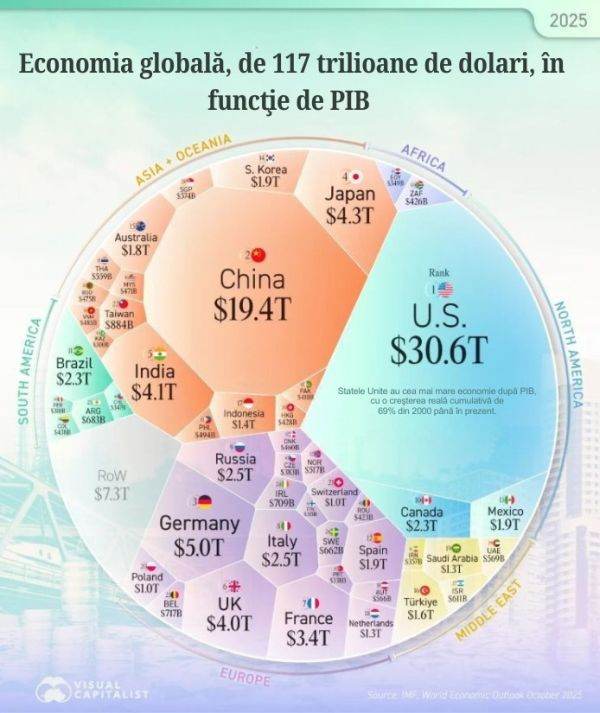
The US economy, at $30.6 trillion, is larger than that of China, Germany and Japan combined, with real US GDP set to grow by 2% this year, according to visualcapitalist.com, which notes that the world economy will reach $117 trillion this year.
By comparison, India's economy is projected to grow by 6.6%, among the fastest growth rates among the world's largest economies. It is surpassed only by Ireland, as export growth is expected to boost GDP by a staggering 9.1% in 2025.
The cited source presents the state of the world economy in 2025, based on projections from the latest report by the International Monetary Fund (IMF).
• The US economy grew by almost 70% between 2000 and 2025
The US economy has grown by about 70% over the past 25 years, in inflation-adjusted terms. On an annual basis, the average growth rate was 2.1%, the third fastest among the ten largest economies today.
China is in second place in the ranking of global economies, with a GDP of $19.4 trillion, growing by 4.8% annually. China's economy grew by 586% between 2000 and 2025.
Germany is in third place, with a GDP of $5 trillion, growing by 0.2% annually. Over the past 25 years, Europe's largest economy has expanded by 27.8%. The cited source mentions that Germany has experienced decades of particularly slow economic growth. The country's economy contracted in both 2023 and 2024. In addition to weak productivity growth, Germany's manufacturing sector has been in decline since 2018.
Similarly, many European countries have seen average growth of less than 2% over the past 25 years. Italy, the world's eighth-largest economy (GDP of $2.5 trillion), saw average GDP growth of just 0.4%, while France (GDP of $3.4 trillion) saw growth of just 1.2%.
In fourth place in the world's economies is Japan, with a GDP of $4.3 trillion, up 1.1%. Over the past 25 years, Japan's economy has grown by 16.6%.
Ranked fifth, India's economy has grown 364% in the past 25 years, and its GDP reached $4.1 trillion in 2025. Next year, India is expected to surpass Japan to become the world's fourth-largest economy.
• IMF improves global growth forecast
The International Monetary Fund (IMF) revised up its global economic growth forecast for this year in October to 3.2%, from 3% in July and 2.8% in April, according to Reuters.
But the international financial institution warned that escalating trade tensions between the United States and China could significantly affect global GDP, even if the shock of tariffs and financial conditions had a weaker impact than expected.
Recent trade agreements between the United States and some major economies have avoided the worst effects of retaliatory measures, which led the IMF to improve its economic forecasts for 2025, for the second time since April, notes Agerpres.
In 2026, the world economy is expected to expand by 3.1%, a level similar to that forecast by the IMF in July.
"In addition to lower-than-expected tariffs, global GDP growth was supported by the private sector, the recovery of supply chains, the depreciation of the dollar, fiscal stimulus measures in Europe and China and the boom in investment in artificial intelligence (AI)," said Pierre-Olivier Gourinchas, the IMF's chief economist, warning that the escalation of trade tensions between the United States and China could affect the advance of the global economy and increase uncertainties, reducing investment and spending.
Under the IMF's baseline scenario, the US, the world's largest economy, is expected to grow by 2% in 2025, up from 1.9% forecast in July. In 2026, US GDP growth is expected to reach 2.1%, a slight improvement on the July estimate but well below the 2.8% growth in 2024.
The eurozone is expected to expand by 1.2% this year, down from 1% forecast in July, thanks to fiscal measures in Germany and continued solid growth in Spain.
Japan is expected to grow by 1.1% this year, down from 0.7% forecast in July, as domestic consumption picks up on rising wages. Next year, it will grow by just 0.6%, down from 0.5% forecast in July.
The IMF's forecast for China was maintained at 4.8% in 2025, following the increase in exports, and at 4.2% in 2026.
Global inflation is expected to be 4.2% in 2025 and 3.7% in 2026, amid rising consumer prices in the United States and downward revisions in some Asian exporters, including China, India and Thailand, mainly reflecting slower economic growth, according to the IMF.
The peace agreement between Israel and Hamas, which ended two years of armed conflict in Gaza, represents an opportunity for a lasting economic recovery in the region, said Petya Koeva-Brooks, the IMF's deputy chief economist.
The official explained that the IMF stands ready to cooperate with the international community to recover Gaza and the economies of the region, which have been deeply affected by the conflict, including Egypt and Jordan.
• IMF calls for deficit, debt reduction
The highly uncertain outlook makes fiscal reforms more important than ever, and the International Monetary Fund (IMF) is urging both advanced and developing economies to reduce their debt levels, deficits and strengthen their capital reserves, according to Vitor Gaspar, director of the IMF's Fiscal Affairs Department, quoted by Reuters.
In its October Fiscal Monitor, the IMF warned that rich countries already have public debt levels of more than 100% of GDP, or are on track to exceed this level, including the United States, Canada, China, France, Italy, Japan and Britain.
By 2029, global public debt is expected to exceed 100% of GDP, reaching its highest level since 1948 and continuing its upward trend, the IMF said, urging countries to strengthen their capital reserves to protect themselves against economic risks.
The IMF official explained that by the end of the decade, the level of global public debt could reach 123% of GDP, "in the case of an adverse but plausible scenario,” close to the record level of 132% of GDP after World War II.
"From our point of view, the most worrying situation would be one in which there would be financial turbulence,” Vitor Gaspar said in an interview, citing an IMF report that showed that financial markets are becoming too accustomed to risks, such as trade wars, geopolitical tensions and large government deficits that, combined with already overvalued assets, increase the chances of a "disorderly” correction in the markets.
These developments could lead to a downward fiscal-financial spiral, similar to the one that emerged during the sovereign debt crisis in Europe, which began in 2010, Gaspar said.
"With significant risks on the horizon, it is important to be prepared, and preparations require capital buffers that allow authorities to respond to severe shocks in the event of a financial crisis. IMF research shows that countries with more fiscal space are better able to limit the negative effects on the labor market and economy in the event of severe shocks combined with a financial crisis,” Gaspar said.
Borrowing is now much more expensive than it was between the 2008 global financial crisis and the pandemic that began in 2020. The increase in interest rates is putting pressure on budgets at a time when needs are high, amid geopolitical tensions, extreme weather events and an aging population, the IMF official said, adding: "While we recognize that the fiscal equation is difficult for politicians to introduce, now is the time to prepare, targeted measures for spending allocated to education and infrastructure that increase GDP are needed.”
Allocating just one percentage point of GDP from current spending on education and other investments in human capital could increase GDP by more than 3% by 2050 in advanced economies, and almost double in emerging and developing countries, according to the IMF.





























 Euro
Euro Dolar SUA
 Franc elveţian
 Liră sterlină
 Gram de aur